Golf · Instruction
Better Putting Takes Three Things. Most Golfers Have None of Them.
Before you blame your stroke, your nerves, or your age, look at the arrangement you've been practicing under. That's where the three-putts are coming from.

It's the five-footer on fifteen that stays with you. Not because you missed it. Because of how familiar the miss felt: the same tentative stroke, the same ball wobbling off line, the same walk up to tap in for a six. You hit the ball well all day. The card says otherwise, and the difference, again, was the putter.
So you make the promise every golfer makes on that drive home: this winter, I'm actually going to work on my putting.
You mean it. You meant it last year too. And somewhere underneath the promise sits the quieter suspicion that maybe this is just your level. That some golfers can putt, and you're not one of them.
That suspicion is wrong, and this article is about why. Not a tip, not a drill, not another gadget. Something more basic: the three conditions putting improvement actually requires, why almost no golfer has them, and what happens when someone finally does.
You've already tried. That's the point.
Think about what working on your putting has actually looked like.
A few minutes on the practice green before a round, rolling putts with half your mind on the first tee. A trip to the course on a free afternoon, maybe twice a month in season, less in winter. Some putts across the carpet while the kettle boils. A training aid, bought with intent, used for a week, now in the garage. A drill you tried for a while until you couldn't remember whether it was helping.
None of that is lazy. It's what working on your putting looks like for almost every amateur golfer, and it almost never changes anything. Season after season, the ball-striking improves and the putting stays where it was.
Here's the part nobody says out loud: none of those attempts failed because you lacked discipline. They failed because every one of them was missing something structural.
Better putting takes three things. A green that behaves like the real thing. That green close enough that you're on it every day. And a plan that tells those minutes what to do.
Three things. Most golfers have none of them. Walk through each one and you'll see your last five years of putting practice explained.
The first thing: a real green
Start with the standard, because the standard is not in dispute. The best putting surface in your golfing life is the one at your course: mown, rolled, measured. Course greens run at a specific speed, 9 to 11 on the Stimpmeter, and a ball struck on one decelerates and hugs its line in a way nothing else quite reproduces. Every putt you will ever hit that matters will be hit on a surface like that.
Now look at what you practice on.

The living room carpet is a different sport played with the same club. The cheap mat is worse than you think: most foam and carpet mats run at Stimp 12 or faster, quicker than any green you will ever play, so they quietly teach you to baby the ball. The surface makes the ball skid where it should roll. The cup is a shallow tray that catches putts a real hole would spit out.
Why this matters so much: your stroke calibrates to whatever surface you give it. Speed, pace, the confidence of the strike. Your hands learn the green you practice on. Give them a false green and they learn a false stroke, and the more sincerely you practice, the more thoroughly they learn it. This is the uncomfortable truth about carpet practice: it isn't neutral. It's training for a course that doesn't exist.
So the first condition is a surface that holds the course's standard. Not something green. Something that rolls at 9 to 11, takes the line, and tells the truth around the hole.
The second thing: it has to be close
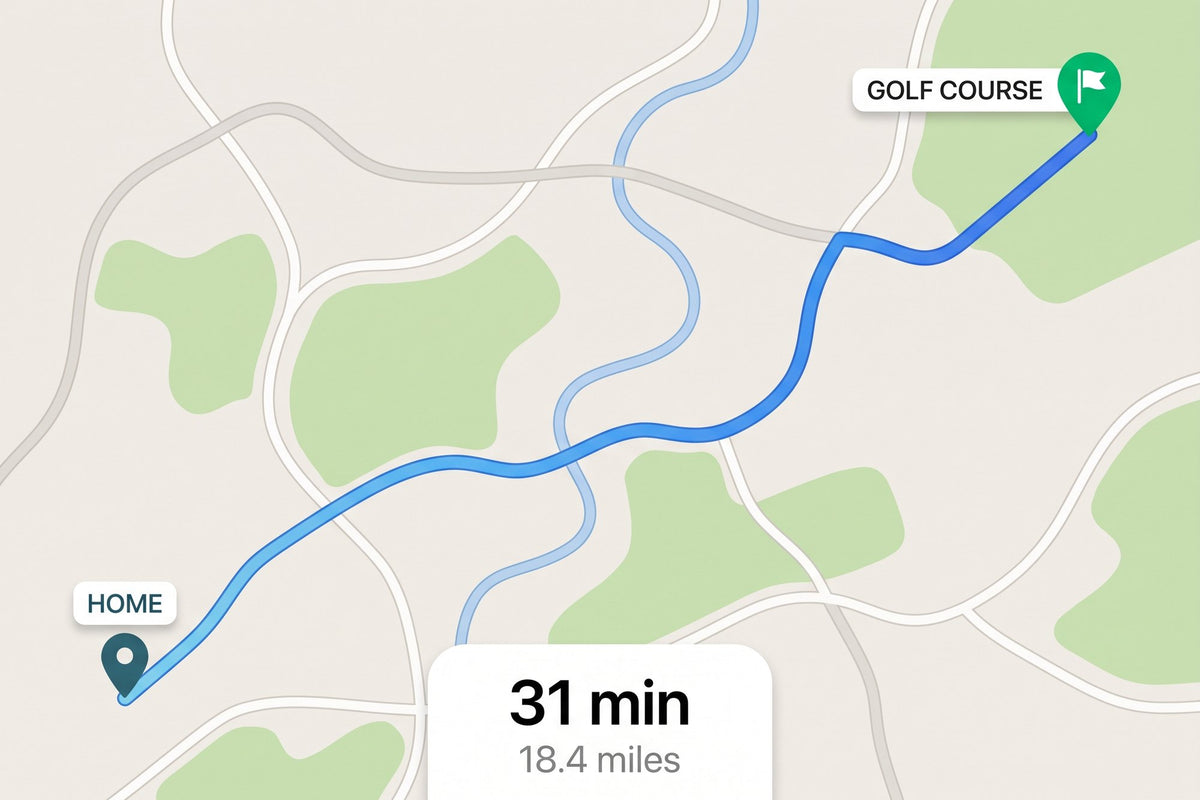
Here's the cruel joke: you already have access to the standard. Your course's practice green is exactly the surface your stroke needs. And it does almost nothing for you, because of where it is.
Improvement compounds only when the repetitions stack, and repetitions stack only when they're frequent. A stroke rebuilt on Tuesday is half-forgotten by the Saturday after next. Practice that happens a couple of times a month isn't a program. It's a series of fresh starts.
And a couple of times a month is what the practice green actually gets, because getting there costs a drive, daylight, and a free hour, and your life has other plans. Be fair to yourself about this. The green across town doesn't lose to your living room because you don't care. It loses because distance always wins.
So golfers split the difference. The standard surface, rarely. The carpet, daily. Which means the surface that counts is the one you're never on, and the surface you're always on doesn't count.
The second condition is the standard within ten steps of where your evenings already happen. Close isn't convenience. Close is what makes practice exist.
The third thing: a plan
Now suppose you solved both. A true surface, in your home. Better, but not enough, because a green, even a perfect one, is just a surface until something tells you what to do on it.
This is the real difference between your practice and a tour player's, and it isn't talent. It's that their minutes are structured. A coach decides what to work on, sets the drill, defines what good looks like, and measures whether it happened. Their ten minutes are decided for them. Yours are improvised: roll a few, see how it feels, stop when it feels fine. Aimless putts groove nothing. Worse, with no target and no record, even a good sign disappears. You can't tell a breakthrough from a mood.
And that is the third gap. It isn't that you don't practice. It's that nothing structures the practice you do. A drill you half-remember from a YouTube video, rolled at no target, with no number attached, teaches your stroke nothing it can keep. You've been showing up. Nothing has been keeping score.
What happens when you have all three
Now hold the three side by side, because something happens when you stop looking at them one at a time.
Say you had all three. Not one, not two. All three.
The green is ten steps from your couch, so the reps happen. With your morning coffee. Between calls. On the winter nights you would never have driven across town for twenty minutes of practice. Nobody finds more time for golf; that isn't how adult life works. But everybody has ten minutes that currently go nowhere, and a green you walk past is a green you use.
The surface is the real thing, so every rep counts. You already know why: the stroke learns whatever green you give it. On a surface that rolls like the course, the stroke you build at home is the same stroke you pull out on Saturday. For the first time, sincere practice goes into the right account.
And a coach structured the ten minutes, so the reps go somewhere. Every drill has a setup, a target, and what good looks like. You're never guessing what to work on, and never wondering whether it counted, because there's a number at the end of the week that says so.
That's the full picture, and it's worth pausing on how it reads next to your own.
The arrangement almost every golfer runs, maybe including you, holds none of the three in full. The real green is across town, visited a couple of times a month, too rarely for anything to stack. The daily surface is a carpet, teaching your stroke a green that doesn't exist. The drills have no coach behind them and no number after them. Three conditions. Three gaps. Years of sincere effort spent on top of that arrangement, and a putts-per-round number that hasn't moved. The problem was never your commitment. It was the arrangement.

The Break 30 Challenge was built to close all three gaps at once.
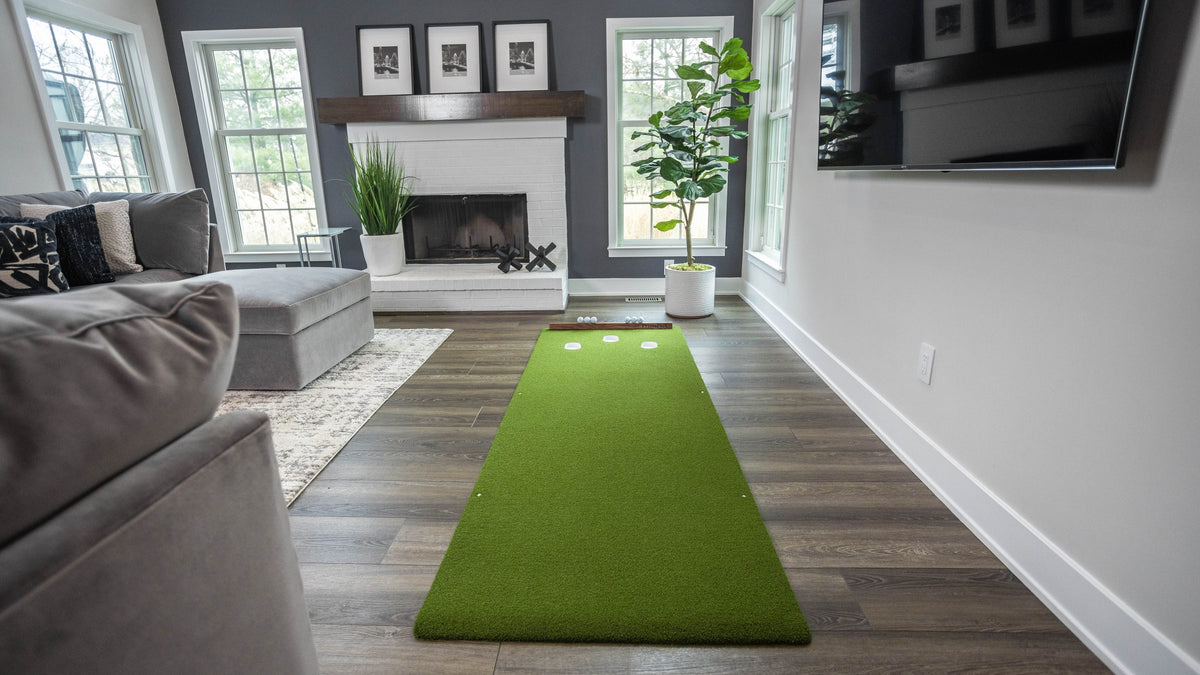
Here is what it assembles.
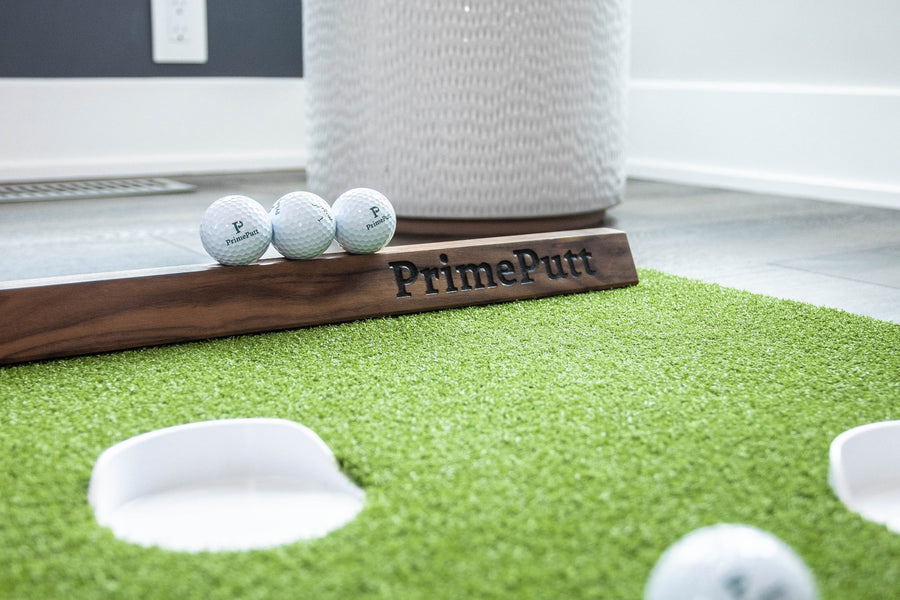
The PrimePutt mat is the first condition, the real green. Its TrueGreen surface is a dense nylon turf built to roll at the speed of a well-kept course green, out of the box, no break-in. The ball slows and tracks the line the way it does on grass. The cups are shallow with a calibrated lip, so they catch what a course catches and reject what a course rejects; a putt that drops, dropped for real. And it lies flat from the first unroll, so the surface your eye learns is a true one.
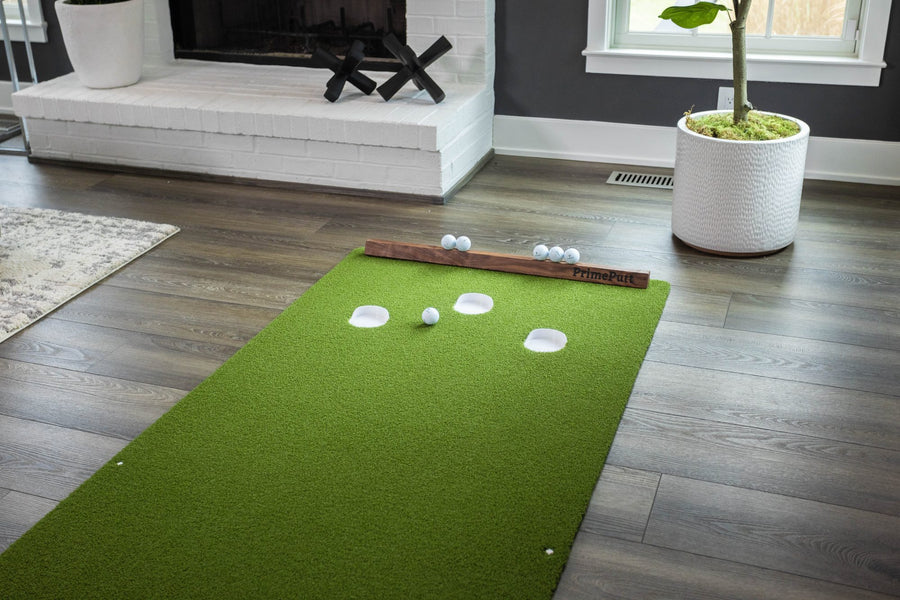
Your home is the second condition, the access. The mat unrolls in seconds and rolls up as fast, and the walnut backstop looks good enough that most owners never put it away. That detail isn't decoration. A green that lives in your living room is a green you're on every day, and every day is the whole point.
The PGA Structured Practice System is the third condition, the plan. Drills from a PGA coach, each with the setup, the target, and what good looks like, plus trackers to keep score. And the benchmark is built in: the 36-Putt Skills Test the day your mat arrives, at home or on a real green, and again at the end, so what changed is a number measured against your own day one, not anyone else's game.
Now put the Challenge through the three questions you're already silently asking. You asked them the last time you stood in a golf shop holding a training aid. Will this actually work? How long before I see something? And what is it going to cost me to keep doing it?
Will it work? You already know the mechanism: the stroke calibrates to the surface it's built on, and this surface is built to the course's standard, so the stroke you groove is the real one. The practice is a coach's, so the minutes are spent on the right things in the right order. And because you benchmark on day one, you're not asked to believe anything: you take a number when you start, you take it again later, and the improvement is measured, not promised. The old arrangement couldn't even report whether it was helping. This one keeps score from the first day.
How long? Daily reps instead of monthly ones. Ten minutes a day on the right surface with a plan is more focused putting practice in one month than most golfers get in a year of course visits. On the old arrangement the honest timeline was never; you've run that experiment for years and the card already gave you its result. On this one, change shows in weeks.
And the cost of keeping it going? Ten steps, not a drive across town. Ten minutes, not a free afternoon. The thinking already done for you. The old arrangement spent your effort without banking it; this one is cheap enough, in time and willpower, that you'll still be paying it gladly in month three. And the arrangement you keep is the only one that ever changes your game.
This is also why the Challenge is not a mat with accessories. Buy the mat alone, even this mat, and you've covered one condition of three: the reps would count, but nothing makes them happen and nothing makes them go somewhere. The Challenge exists because it's the combination, not any single piece, that moves the number on your card.
The golfers already keeping score
Over 16,000 golfers practice on PrimePutt, and the reviews sit at 4.9 stars across 251 of them. It's the official mat of the Korn Ferry Tour Championship, and the number one putter on the PGA Tour practices on the same surface. But tour proof isn't the interesting proof. The interesting proof is a golfer like you, keeping score.
Paul Newton, a verified buyer, was chasing the same number this article is named for: "I have been trying to reduce my putts to under 30 per round. Since practicing with the mat, I have a 28.7 putts per round average. The biggest improvements have come in distance control and the mechanics of my putting stroke. My consistency is much better."
For context: a scratch golfer averages 31 putts a round. Paul is under it, from his living room.
Believe the reviews this is a very nice piece of equipment. Thought I’d use it once in a while. Use it all the time. Obviously my golf game says I need to use it more but it’s a great practice piece for your home or office wherever you wanna put it.
High quality, realistic mat. I keep it set up because it looks great. This way I can hit a few balls several times daily even others in the room join in.
Excellent surface. I would agree that it rolls around 10’ on the stimp. Very useful to groove a dependable stroke.
Set a goal to sink 100 6-foot putts a day everyday for 100 days. Forty days deep and I’ve topped 70% for the 12th time and just hit 85.5% today! Can’t wait to see how well it translates to the course.
The worst case is a full refund
The Challenge runs on a number, so the guarantee does too. There are two of them, both running a full 60 days, both ending in a full refund. If your putting hasn't improved, send it back. If you simply don't love having it in your home, send it back. Keep the box; if you ever return it, they email you a prepaid label, so trying it costs you nothing.
You've made the winter promise before. The difference this time is what sits underneath it: the course's surface ten steps away, a coach's plan telling the minutes where to go, and a day-one number that keeps everyone honest, including you.
Sixty days later you'll know, either way. That's the whole idea.