


Jordan Spieth takes exactly three practice strokes before every putt. He looks at the hole twice. The entire process takes approximately 22 seconds from the moment he marks his ball to the moment he strikes it. This routine never changes, whether he’s facing a three-footer to win a major or a meaningless putt in a practice round.
This consistency isn’t superstition. It’s strategic. A well-designed pre-putt routine prepares you physically, focuses your mind, and creates a familiar pattern you can rely on when pressure mounts. Without one, you’re starting from scratch on every putt, making decisions in real-time and hoping for the best.
Why Routines Matter
Your brain craves patterns. Repeat the same sequence before each putt and you create a neural pathway that becomes automatic. This matters most under pressure. When your heart’s racing and your hands are shaking, you can’t trust your conscious mind. But you can trust a routine you’ve performed thousands of times.
Think of it as a trigger. A sprinter’s routine in the blocks prepares them for the gun. Your pre-putt routine does the same. By the time you’re standing over the ball, your body already knows what to do.
The real benefit: consistency in your routine creates consistency in your results. When you approach every putt the same way, you eliminate variables. The only variable left is the putt itself.
The Components of an Effective Routine
Every routine needs these elements, though the order is up to you:
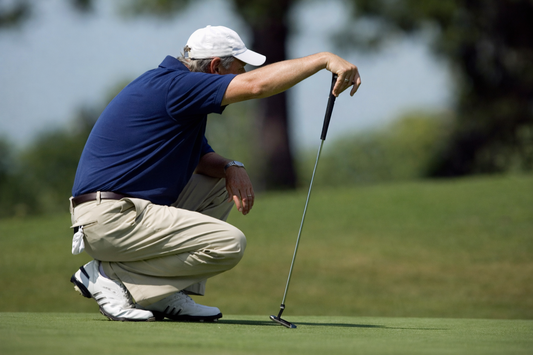
Reading the putt. Most tour players read from behind the ball, looking at overall slope and break. Many check from behind the hole to confirm. Some look from the low side. Gather enough information to commit without overthinking.
Pick a specific target. Not “aim at the right edge,” that’s too vague. Pick that discolored blade of grass three inches right of the hole. Something visual and precise.
Practice strokes. One to three is the sweet spot. They help you feel the distance, rehearse your tempo, and keep your body loose. More than three and you’re overthinking.
Setup. Most players approach from behind, set the putter face square to the target line, then build their stance around it. Others set their feet first, then adjust the putter. Either works. Just be consistent.
Final look. Brief and purposeful. You’re not re-reading, you’re confirming your target and visualizing the ball rolling on your line.
The trigger. A forward press. A deep breath. Counting to yourself. Doesn’t matter what it is. Just have one. It marks the shift from preparation to execution.
Timing Your Routine
Aim for 15 to 30 seconds from marking your ball to striking it. Shorter feels rushed. Longer and you’re overthinking.
Tour players work toward the shorter end because they’ve already read while others are putting. Amateurs need a bit more time. That’s fine.
What matters is consistency. If your routine takes 22 seconds, it should take 22 seconds every time. Not 15 on an easy three-footer and 35 on a tricky downhiller. When your timing varies, you’re letting the situation dictate your process instead of trusting your routine.
Building Your Personal Routine
Film yourself putting and watch what you do naturally. You probably already have a routine, even if it’s informal. Those natural tendencies are your foundation.
Look for inconsistencies. Maybe you sometimes read from behind the ball and sometimes don’t. Maybe your practice stroke count varies. These are your opportunities.
Now design something that includes all the necessary elements. Write it down step by step. Then practice it until it’s automatic: 50 putts focusing only on the process, not the results.
The routine should feel comfortable, not forced. You’re not copying Spieth or anyone else. You’re building something that works for your personality.
Adapting to Different Situations
Your routine stays consistent, but minor adjustments are fine. On a long lag putt, spend more time feeling the distance. On a short putt with big break, take an extra look from the low side.
The keyword is planned. Know in advance you’ll take that extra look on breaking putts. This keeps your routine consistent even when execution varies slightly.
Different conditions require adaptation too. Slow greens? Focus on an aggressive stroke. Fast greens? Emphasize smoothness. But the structure stays the same.
The Mental Component
Your routine isn’t just physical. As you go through it, manage your thoughts. Negative thoughts about missing have no place here. Focus on process: reading the putt, picking your target, feeling the stroke.
Self-talk helps. “Trust it.” “Smooth.” Whatever works. The words matter less than directing your attention to execution rather than outcome.
Visualization is powerful. As you take that final look, see the ball rolling on your line and dropping in. Your brain doesn’t distinguish clearly between imagined and real experiences, so this mental rehearsal primes your body to execute what you’ve visualized.
Maintaining Your Routine Under Pressure
The real test comes when pressure’s on. Can you execute the same routine on a three-footer to win the match as you do on a meaningless practice putt? Most golfers can’t. They speed up, add extra looks and second-guess themselves.
Solution: Practice your routine under pressure. Create situations on the practice green where putts matter. Hole ten in a row from three feet. Play games with consequences. The more you practice under pressure, the more automatic it becomes.
When you feel yourself wanting to deviate, that’s exactly when you need to stick to it. Your routine is your anchor. The one thing you control when everything else feels chaotic.
The Long-Term Benefits
A solid routine pays off. Your putting becomes more consistent. Bad days won’t be as bad because you’re still following your process. Good days get even better because you’re not in your own way.
You’ll putt better under pressure. When the match is on the line, you won’t freeze. You’ll just execute your routine like you’ve done thousands of times before. This confidence can’t be bought or taught; it can only be earned through practice and trust.
Your routine is your competitive advantage. It separates you from players with similar physical skills but less mental discipline. Build it carefully, practice it religiously, and trust it completely.


