
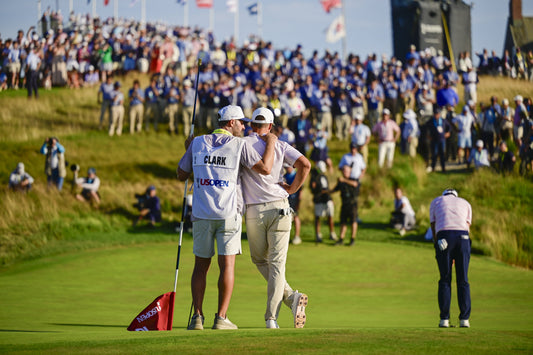


What Wyndham Clark’s U.S. Open Win Really Taught Us
Compiled by Multiple-Award-Winning PGA Professional Brendon R. Elliott, PrimePutt’s Director of Instruction and Lead Writer
Wyndham Clark did not win the U.S. Open because the final round was easy.
He won because the final round got uncomfortable and his putter kept giving him room to breathe.
That is the most important putting lesson from Shinnecock Hills.
Clark entered Sunday with a six-shot lead. By the time the final few holes arrived, Sam Burns had turned a coronation into a real chase. The lead was down to one. The crowd was loud. The golf was not clean. The course was still asking for discipline.
That is where pressure putting becomes more than technique.
It becomes survival.
The Putt That Saved The Championship Was Not A Make
Everyone loves the made putt.
The 25-foot birdie on the par-5 16th mattered. Of course it did. Clark had found thick fescue off the tee, then still managed to give himself a chance. When the putt dropped, it gave him the margin he needed before a three-putt bogey at the 17th.
But the putt that really explains the win came on 18.
Clark’s approach finished 52 feet below the hole. At that moment, the championship was not asking him to be spectacular. It was asking him to be mature. One bad first putt and Burns gets another opening. One careful, committed lag and Clark gets the trophy.
He rolled it to 9 inches.
That is pressure putting.
Not always making it. Not always being heroic. Sometimes pressure putting is making the next putt unnecessary.
The Hidden Skill: Speed Before Line

Most amateurs reverse the order under pressure.
They obsess over line first. They crouch lower. They read more. They rehearse more. They try to will the ball into the hole with precision.
The best players know speed is the first separator.
At Shinnecock, Clark’s putting was not just about holing putts. It was about never letting the speed completely run away from him. He made five putts from over 20 feet during the week, more than anyone in the field, but he also survived because his speed control helped him manage stress after imperfect shots.
That is what amateurs should copy.
You do not need a U.S. Open stroke.
You need a U.S. Open priority.
Speed first.
YTD Putting Watch
This is the weekly reminder that putting success is not only about one heroic moment. It is about repeatable skill, better speed control and eliminating the mistakes that turn solid rounds into frustrating ones.
PGA Tour YTD Putting Leaders
Strokes Gained: Putting
Vince Whaley leads at +0.780.
Putts Per Round
Eric Cole leads at 27.46, with the PGA Tour average listed at 28.90.
Overall Putting Average
Eric Cole leads at 1.526.
Putting Inside 10 Feet
Matt Kuchar leads at 91.98%.
3-Putt Avoidance
Jimmy Stanger leads at 1.11%.
LPGA Tour YTD Putts Per Round Leaders
-
Mi Hyang Lee: 28.03
-
Hyo Joo Kim: 28.07
-
Minami Katsu: 28.38
-
Patty Tavatanakit: 28.41
-
Alexa Pano: 28.48
PrimePutt read: The names matter, but the pattern matters more. The best putters are not just making more. They are wasting less. They control speed, clean up short putts and reduce the emotional damage of a miss.
PrimePutt Practice Takeaway
When pressure rises, your putting routine should get simpler, not busier.
Use this order:
1. Read The Big Slope First
Do not start with tiny details. See the overall fall, tier or ridge.
2. Pick The Speed Window
Ask: “Where should this ball finish if it does not go in?” That answer matters more than the perfect line.
3. Commit To A Picture
See the ball rolling through the entry point, not just starting on a line.
4. Finish Balanced
A balanced finish tells you the stroke was not rushed by nerves.
Here’s Your Drill: The 52-Foot Lag Ladder
You do not need exactly 52 feet. Use 30, 40 and 50 feet if that fits your practice space.
Place three tees or coins in a ladder, each 10 feet apart. Roll three balls to the first, three to the second and three to the third. Your goal is not to hole them. Your goal is to leave every ball inside a three-foot circle.
Then repeat, but add consequence.
If one ball finishes outside the circle, start the ladder over.
That adds just enough pressure to make your body want to rush.
Your job is to stay smooth.
Final Thought
Clark’s U.S. Open win will be remembered as wire-to-wire, but Sunday was not a straight line.
It was messy. It was tense. It was human.
That is why it was useful.
The best pressure putts are not always the ones that disappear into the cup. Sometimes they are the ones that make the next putt easy.
Pressure Putts drops every Monday with the week’s best putting stories, stats and drills from the PGA Tour, LPGA Tour and DP World Tour. Got a putting question or drill request? Drop us a line.


