


Compiled by Multiple-Award-Winning PGA Professional Brendon R. Elliott, PrimePutt’s Director of Instruction and Lead Writer
Some weeks, putting is not just part of the story. It is the story.
This was one of those weeks. In San Antonio, a wet and chaotic Sunday turned the Valero Texas Open into a nerve test. In Las Vegas, Lauren Coughlin won at Shadow Creek without needing a cartoonishly hot putter, just a steady one. At Augusta National, María José Marín showed what happens when touch and conviction stay married for 54 holes. And at the Drive, Chip and Putt National Finals, kids on the 18th green gave us a master class in what pressure looks like before a paycheck, a ranking, or a résumé ever enters the picture.
Valero Was About The Putts That Arrived Late
J.J. Spaun won the Valero Texas Open at 17-under with a final-round 67, and the lasting image was not some weeklong putting clinic where he lapped the field. It was the timing of the putts and the nerve attached to them. Spaun converted an eagle putt on the 17th to take the lead, then finished the job with a clutch par on the last. Meanwhile, the event’s Strokes Gained: Putting leaders were Jacob Bridgeman, Jake Knapp and Vince Whaley, which makes Spaun’s win even more interesting. He did not need to be the statistical king of the week. He needed to be the calmest man on the green when the week closed in on him.
That is a useful reminder for the rest of us. A lot of golfers think pressure putting means holing everything from everywhere. Usually, it means something simpler. It means handling the one putt that changes the round. The one that keeps momentum alive. The one that prevents a loose finish from becoming a damaging one. Spaun’s week said a lot about ball-striking, but it also said this: you do not have to dominate every green to win a tournament or save a card. You do have to be poised when one putt suddenly matters more than the previous 60. That is where practice should live for most golfers, in those makeable moments from 6 to 15 feet when the round starts to lean one way or the other.
Coughlin Won Shadow Creek With Order, Not Chaos

Lauren Coughlin’s Aramco Championship win came across differently. She went wire to wire, finished at 7-under and won by five over Leona Maguire and Nelly Korda on a week when Shadow Creek possessed plenty of bite. Reuters noted that she birdied the first and eighth holes in the final round and stayed composed the rest of the way, which fits the larger picture of how she handled the week.
The most telling part of her week might be what the 54-hole stats said before Sunday even started. Through three rounds, Coughlin had taken 88 putts with 70 GIR putts at 1.71 and only one 3-putt. Nelly Korda actually had fewer total putts at 84 and zero 3-putts through 54 holes, while Miyu Yamashita was even tidier with 76 total putts and 1.56 GIR putts. In other words, Coughlin was not winning because she was making everything from all over Nevada. She was winning because her full game stayed organized and her putting never let the week wobble. That is a version of pressure putting too, and it is one amateurs often overlook. Sometimes the best putting performance is not the loudest. Sometimes it is the one that keeps a round from leaking.
That is a lesson worth stealing. Stop chasing only makes. Start valuing structure. Fewer three-putts. Better first-putt pace. Shorter stress coming back. If your lag putting improves, your pressure putting improves with it. Coughlin’s win at Shadow Creek was a strong argument for that.
Marín and Augusta National Proved That Touch Has To Survive Emotion

At the Augusta National Women’s Amateur, María José Marín won at 14-under with rounds of 65, 69 and 68, and Masters.com noted that the score set a new championship record by two. Before the week, Marín had already said that winning this championship requires putting well because both courses feature complex greens. That turned out to be about as honest and accurate a preview as anyone could offer.
The flip side of that truth showed up in painful fashion. Asterisk Talley took a one-shot lead into Saturday at 11-under through 36 holes, then Augusta National did what Augusta National does when conviction slips. Talley’s back nine unraveled, most notably with a quadruple bogey at the 12th, and she eventually finished tied for fourth at 8-under. Marín did not win only because someone else stumbled. She won because she kept her feel and her head in the same place while the course got louder around her. But the contrast was revealing. On severe greens, the pressure putt is often not the birdie try. It is the next one, the one after a miss, a scare, or a spike in heartbeat.
For everyday golfers, Augusta’s lesson is not “be more aggressive.” It is “pick a smart speed and accept the next putt.” Too many players on slick greens putt defensively and then act surprised when they leave themselves a nervy comebacker. Marín’s week is a reminder that touch is not just mechanical. It is emotional. The best putters keep the size of the moment from speeding up the stroke.
Drive, Chip and Putt May Have Given Us The Best Putting Lessons Of All

Then came Sunday at Augusta National and the Drive, Chip and Putt National Finals, where the purest pressure putting of the week might have lived.
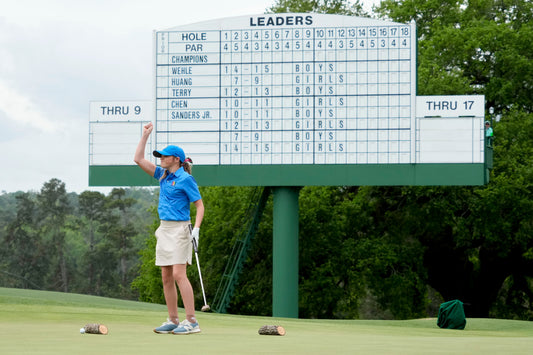
Riley Huang won the Girls 7-9 division by answering Patricia Kittivat in a playoff with two holed 15-footers on the 18th green. Ava Chen won the Girls 10-11 division with one highlight being a made uphill 30-footer. Lucy Cui took the Girls 12-13 title by sinking both putts. Nirvika Koduru rolled in the 30-footer in the Girls 14-15 group. Stephen Sanders hit a putt to 10 inches. Texas Terry left his two putts a combined 2 feet, 14 inches from the hole. And Arno Wehle described his lag-putting picture with one of the best quotes of the week, saying he imagines a “big pizza” and is simply trying to roll the ball into that zone. Officially, the putting portion used two putts from 15 and 30 feet on Augusta National’s 18th green, with cumulative distance deciding the score.
There is so much to love in that. Those kids did not make it overly complicated. They matched the speed to the picture. They trusted simple targets. They accepted the moment instead of wrestling with it. Honestly, many grown golfers would do well to adopt that mindset immediately. Give yourself a zone. Roll the ball into it. Let the picture calm the mechanics. Wehle’s “pizza” might be the best amateur putting image of the spring.
What PrimePutt Readers Should Steal From This Week
If you are a lower-handicap player, the big takeaway is this: own the scoring range. Spaun’s finish in Texas and Huang’s playoff at Augusta both pointed back to the same truth. Pressure lives in that makeable window, not in your casual practice strokes. Train 6 to 15 feet with consequences. Make two in a row before moving on. Miss one and restart.
If you are a mid-handicap player, this week screamed for better lag putting. Coughlin’s win and the DCP finals both reinforced how much value lies in turning 30 feet into tap-in territory. The sexy putt is the one that drops. The score-saving putt is often the one that never leaves stress behind.
If you are a higher-handicap player, start with a smaller goal: eliminate the foolish second putt. Augusta, Shadow Creek and even the DCP setup all showed the same principle. Distance control is dignity. Get the first one close enough that the next one does not ask for heroics.
YTD Putting Snapshot
On the LPGA, the current Putts Per Round top five are Mi Hyang Lee at 27.25, Minami Katsu at 27.29, Minjee Lee at 27.63, Alexa Pano at 27.75 and Hyo Joo Kim at 27.88.
On the PGA TOUR, Jacob Bridgeman and Jake Knapp sit 1-2 in SG: Putting at 1.339 and 1.285 through the Valero Texas Open, and Knapp also leads TOUR Putts Per Round at 27.27.
That is what made this such a rich Pressure Putts week. We saw a TOUR winner who hit the right putts late, an LPGA winner who kept her card neat under pressure, an ANWA champion who handled Augusta’s most demanding surfaces like she belonged there and kids at Drive, Chip and Putt who reminded every adult watching that the best putting often comes back to pace, trust and a clear picture.
Different stages, different ages, same truth. When the nerves show up, the steadiest putter usually gets the last word.
Pressure Putts drops every Monday with the week’s best putting stories, stats, and drills from the PGA TOUR, LPGA, and DP World Tour. Got a putting question or drill request? Drop us a line.