
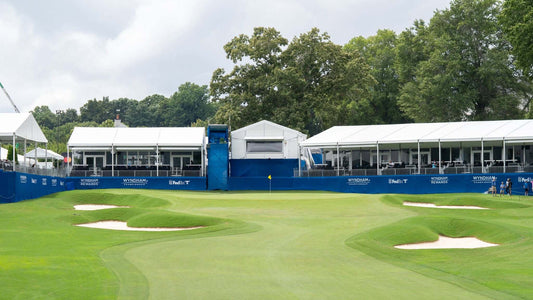


At Sedgefield, the approach shot is the first putt.
Compiled weekly by multiple-award-winning PGA Professional Brendon R. Elliott, PrimePutt’s Director of Instruction and Lead Writer.
This week’s putting assignment can be reduced to one principle: Do not leave yourself in the wrong neighborhood.
The LPGA Tour is taking a scheduled week off following the AIG Women’s Open, with its next event, The Standard Portland Classic, beginning Aug. 13. That allows this edition of The Greens This Week to concentrate entirely on Sedgefield Country Club, where the Wyndham Championship closes the PGA Tour’s regular season.
Sedgefield measures 7,131 yards and plays to a par of 70, but those numbers do not explain its real defense. The putting surfaces average approximately 6,000 square feet and are covered with Champion bermudagrass maintained at 0.120 inches. They are large enough to offer options, yet contoured enough to make many of those options uncomfortable.
A player can hit a green in regulation and still face a first putt that feels more like damage control than a birdie opportunity.
Sedgefield Makes Position More Important Than Proximity
Donald Ross greens rarely present one broad, uncomplicated target. Their slopes, raised edges, internal rolls and falloffs divide the putting surface into smaller usable areas.
That pattern appears immediately at Sedgefield. The first green is raised and leans from right to left. The second tilts toward a creek. The fourth is bunkerless, but the official course description identifies it as one of the most undulating and demanding greens on the property.
At the par-5 fifth, a deep hollow runs diagonally across the putting surface. No. 9 features a severely sloping, scalloped-edge green where finishing long can make saving par extremely difficult. The 10th is described as the most severe green on the course, while the par-3 12th features a dramatic two-tier target built into the face of a hill.
This is why approach-shot discipline matters so much.
The flag may be visible, but that does not make it the proper target. A shot that finishes 18 feet below the hole could be significantly more valuable than one that stops 10 feet away on the wrong tier or above a pronounced slope.
The challenge becomes even sharper late in the round. The 14th has the largest green on the course, but it slopes severely from back right to front left. No. 17 has the smallest green at Sedgefield, and the 507-yard finishing hole concludes with a severely undulating hilltop surface. The most difficult location on the 18th is positioned atop a large roll in the back-right portion of the green.
For contenders, the final approach may require a choice between chasing the hole and protecting against a potentially round-altering first putt.

Champion Bermuda Adds Another Layer
Champion is an ultradwarf bermudagrass developed to produce a dense, fine-textured putting surface at low mowing heights. The GCSAA tournament fact sheet lists Champion bermudagrass on the greens, with bermudagrass also covering the collars and approaches. That creates a relatively consistent turf family around the targets, but it does not mean every putt or recovery will behave identically.
When grain is present, it can affect pace and break. A putt traveling against the grain may roll more slowly, while one moving with it can carry additional speed. Grain can also amplify the movement of a sidehill putt. However, golfers should not fall back on oversimplified rules about grass always growing toward water, the setting sun or another fixed landmark. The USGA notes that grain can develop in multiple directions and that modern ultradwarf bermudagrasses generally have a more upright growth habit than earlier varieties.
The best players will combine slope, surface appearance and the behavior of earlier putts rather than trusting one visual clue.
That type of observation becomes especially valuable during practice rounds and the opening holes Thursday. A putt that rolls differently than expected is not merely a missed opportunity. It is information that should improve the next read.
Weather Could Change the Effective Pace
Sedgefield’s agronomy operation is led by Chad Cromer, who has spent 11 years at the club and has worked 22 professional events during his career. The tournament operation includes 20 agronomy employees and 45 volunteers preparing the property.
The current Greensboro forecast calls for humid conditions throughout the tournament, with the possibility of scattered afternoon thunderstorms each day. High temperatures are expected to remain in the mid-to-upper 80s.
The fact sheet lists clay soil and average drainage. That does not guarantee soft greens or slower putting surfaces, but periods of rainfall could influence moisture, receptiveness and the effective pace of putts. Sunshine, humidity, wind and maintenance decisions between storms may produce additional changes during the week.
Players cannot assume the green that received a morning approach will react exactly the same way late in the afternoon.
No current Stimpmeter target was provided, so assigning a specific speed would be speculation. The more useful question is whether each player can recognize a change quickly enough to adjust before it becomes a string of three-putts or missed comebackers.
What the Greens Are Asking
Sedgefield is asking players to solve three connected problems.
First, they must find enough fairways to control the approach. The course has only 25 acres of fairway, and missed drives can settle into bermudagrass rough maintained at 2.5 inches. From there, predicting launch, spin and rollout into a sloped green becomes more difficult.
Second, they must identify the correct section of each green. A regulation approach that crosses a tier, hollow or severe side slope may create more difficulty than a conservative shot finishing several yards farther from the flag.
Third, they must recalibrate throughout the round. Moisture, grain, changing hole locations and the direction of a putt across a Ross contour can alter the required pace.
The field will make birdies at Sedgefield. The course has produced low winning totals before. The separator may be which players create those birdie chances without repeatedly exposing themselves to the most defensive parts of the greens.
The PrimePutt Read
Watch where the contenders finish their approach shots, not simply how close they finish.
Are they consistently putting uphill? Do they leave the ball on the same tier as the hole? When they miss, does the ball finish in a location that allows an aggressive recovery, or are they forced to putt defensively across a ridge?
Pay particular attention to Nos. 10, 12, 14 and 18. Each presents a different version of the same question: Will the player accept a safe section of the green, or challenge a location that could produce either birdie or immediate trouble?
The leaderboard will show who made the most putts. The approach patterns will help explain why those putts were makeable.
The PrimePutt Drill: The Ross Leave Challenge
Most golfers judge lag putting only by distance from the hole. This drill adds another standard: the side of the hole where the ball finishes.
Choose a breaking putt of 20 to 30 feet. Use four tees to create a 3-foot semicircle on the low side of the hole. That is your preferred leave zone.
Hit 10 putts, completing your full read and routine before each attempt.
Score the drill this way:
-
3 points: Hole the putt.
-
2 points: Finish inside the 3-foot low-side zone.
-
1 point: Finish within 3 feet, but outside the preferred zone.
-
0 points: Finish more than 3 feet away.
Your target is 20 points out of a possible 30.
After the first set, reverse the break or move to a different slope. The goal is not to steer the ball short. It is to match line and pace well enough that a miss finishes in the easiest possible location.
On a PrimePutt mat, create a stopping window 12 to 24 inches short of the primary target. Alternate between trying to finish in that window and rolling the ball to the full target. This develops the ability to change speed intentionally rather than repeating one comfortable stroke.
PrimePutt Takeaway of the Week
Golfers often choose approach targets by asking one question: How close can I get to the flag?
Sedgefield demands a better one: Where do I want my first putt to begin?
That distinction matters on every course. The easiest birdie opportunity is not always the shortest putt, and the best approach is not always the shot aimed directly at the hole.
The winner of the Wyndham Championship will likely make plenty of putts. More revealing will be how rarely the champion asks the putter to repair an approach shot that finished in the wrong neighborhood.


