


PGA Championship Edition
Compiled weekly by multiple-award-winning PGA Professional Brendon R. Elliott, PrimePutt’s Director of Instruction and Lead Writer.
There are major championship venues where length feels like the headline. Aronimink Golf Club is not quite that.
Yes, the 2026 PGA Championship setup will stretch to roughly 7,400 yards and play as a par 70. Yes, the modern player will still need to drive it with power, control and nerve. But the deeper test at Aronimink will likely begin once the ball starts working its way toward Donald Ross’ greens.
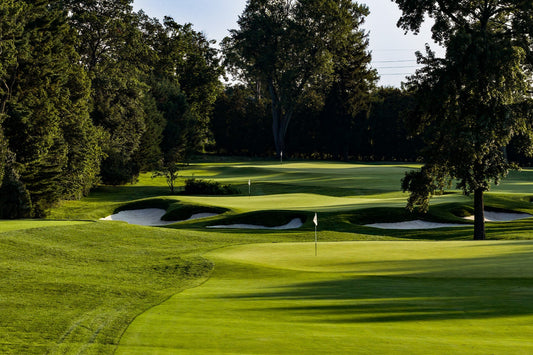
This week, the PGA Championship comes to Newtown Square, Pennsylvania, and into the hands of a classic Ross design that was restored with great care by Gil Hanse. That combination matters. Ross’ best greens do not need tricks. They tilt, crown, repel, gather and ask players to think before they swing. Hanse’s restoration brought back scale, shape and strategy, including expanded putting surfaces, restored bunkering and a more authentic version of the course’s original intent.
For PrimePutt, that makes Aronimink one of the most interesting putting weeks of the year.
The Surface: Bentgrass, Contour and Championship Pace
Aronimink’s putting surfaces are Penn A-1/A-4 bentgrass, maintained at .100 inches for championship week. The collars are also Penn A-1/A-4 bentgrass at .250 inches, with L-93 bentgrass approaches at .350 inches. The average green size is a generous 8,200 square feet, but that number can be deceiving because Ross greens rarely play as large as they measure.
That is the first key for the week.
Players may see plenty of putting surface, but they will not always see plenty of usable putting surface. On classic Ross greens, being technically “on the green” is not the same as being in position. The wrong tier, wrong shoulder or wrong side of a subtle fall line can turn a routine two-putt into a defensive lag and a nervy cleanup.
That is where putting becomes more than stroke mechanics. It becomes judgment.
At Aronimink, the best putters will not simply be the players who roll in the most 20-footers. They will be the players who control speed from distance, read slope with patience and leave the ball in places where the next putt is manageable.

Why Ross Greens Still Travel Through Time
One of the best things about Donald Ross’ architecture is that it continues to ask elite players old questions with modern clubs in their hands.
The golf ball goes farther. Drivers are bigger. Launch monitors have changed preparation. But a player still has to stand over a slick, breaking six-footer with a major on the line and decide how much speed the putt deserves.
Aronimink leans into that reality.
Ross’ greens here are known for contour, crowned edges and the kind of interior movement that can make a putt appear simple until the final third of its roll. PGA of America’s preview of the venue highlighted the challenge of reading these greens, especially the “subtle breaks” within larger contours.
That phrase is important. Subtle breaks are often what separate good putting weeks from great ones.
Big slope is obvious. Every player sees it. Subtle movement is where uncertainty lives. It is where a player starts wondering whether the putt is inside left or a cup out. It is where grain, pace, moisture and late-afternoon foot traffic can change the picture just enough to matter.
At a major, those tiny decisions pile up.
The Weather Watch: Firm, Soft or Somewhere in Between?
The early forecast for Newtown Square calls for showers possible on Thursday and Friday, followed by warmer weekend conditions, with Saturday looking pleasant and Sunday bringing warmth and the possibility of an afternoon thunderstorm in parts of the area.
That could shape the entire putting story.
If Aronimink gets moisture early, approach shots may hold a little better and players may be able to be more aggressive with hole locations. Softer greens can also keep more players in the championship because recovery shots become slightly less punishing.
But if the course dries out into the weekend, the championship could sharpen quickly.
Firm Ross greens are a different test. A ball landing on the wrong section can release into a collection area. A downhill putt can become a survival putt. A player chasing from behind may have to decide whether to attack a tucked hole or accept a longer putt from a safer angle.
That is when Aronimink can reveal its teeth.

The Hole Locations Will Matter More Than The Stimp Number
Everyone loves to talk about green speed during a major. It is natural. Fast greens look dramatic on television, especially when a ball trickles past the hole and keeps moving.
But at Aronimink, the more important question may not be “How fast are they?”
It may be “Where are the holes?”
Ross greens, especially ones with restored size and shape, give setup teams options. The PGA of America has studied the more contoured greens at Aronimink closely, with attention on keeping hole locations challenging without becoming unreasonable.
That balance is the art of championship setup.
A hole cut on the proper section can reward a great iron shot and still demand a committed putt. A hole cut near a ridge, shoulder or fall-off can make players think twice about missing on the aggressive side.
For viewers, this is what to watch: when a player hits what looks like a decent approach and still faces a wildly uncomfortable putt, that is not bad luck. That is architecture doing its job.
The 11th Green Could Be The Week’s Most Important Putting Surface
If there is one green to circle from a PrimePutt perspective, it is the 11th.
Gil Hanse pointed to No. 11 as one of the toughest challenges players will face, especially when they are out of position or coming into the green from the wrong angle. Golf Digest also described the 11th as the most severely sloped green on a course full of severe putting surfaces, with above-the-hole misses creating serious three-putt danger.
That is exactly the kind of hole that can change a major.
The best players in the world can survive a missed fairway. They can survive a bunker. They can even survive a poor approach if the miss is in the correct place. What they cannot survive, at least not repeatedly, is leaving themselves on the wrong side of a Ross green with speed running away from them.
No. 11 will test more than putting touch. It will test discipline.
The smart play may be 20 feet below the hole instead of 12 feet above it. The smart miss may be short and safe rather than pin-high and dead. The player who accepts that early in the week may save two or three shots by Sunday.
The 13th Could Create The Loudest Putting Swings
The 13th is a short par 4 that may become drivable during the weekend, thanks to a forward tee that creates a risk-reward setup. The green is well-contoured, with danger left and the potential for momentum-changing birdies or eagles.
That makes it a fascinating putting hole.
Short par 4s in majors are often remembered for tee shots, but the putting is usually where the score is truly decided. A player who drives it near the green may still face an awkward pitch to a sloping surface. A player who lays back may have a wedge in hand, but only if the angle is right.
From a putting standpoint, the 13th could produce several kinds of drama:
-
A reachable eagle putt that suddenly feels faster than expected
-
A delicate birdie putt from above the hole
-
A three-putt par after what looked like a perfect aggressive play
-
A late Sunday decision where the leader chooses position over flash
That is why short par 4s are so good in major championships. They tempt players into thinking the hard part is over before the ball ever reaches the green.
The Finishing Stretch Will Demand Complete Speed Control
No. 16, a par 5, should provide a scoring opportunity. No. 18, now stretched with a newer back tee, plays uphill toward a partially obscured green and can reach 490 yards. Hanse called 18 a classic American parkland finishing hole where players climb back toward the clubhouse and face difficulty judging the hole location from a lower elevation.
That final green could be a brutal place to win or lose a Wanamaker Trophy.
Late Sunday putting is different. The hands feel different. The routine feels longer. The hole can look smaller, especially on a surface with brows, pockets and subtle internal movement.
The player who wins at Aronimink will likely have to do at least one of three things down the stretch:
-
Cozy a long lag putt into tap-in range when adrenaline is high
-
Trust a short breaking putt with the championship still undecided
-
Choose the correct leave on an approach rather than chase a flag that does not need to be chased
That last point may be the most important.
Great putting weeks often begin before the putter is ever pulled from the bag.

The PrimePutt Key: Match Speed To Slope
For everyday golfers watching this week, Aronimink offers a lesson that applies far beyond major championship golf.
The lesson is simple: speed and slope have to work together.
Most amateurs read putts as if the line is the only question. Tour players know the line only exists because of the speed. On greens with meaningful contour, the same putt can break a little, a lot or almost not at all depending on how firmly it is rolled.
That will be obvious at Aronimink.
When players are putting from above the hole, watch how soft the stroke looks. When they are putting uphill, watch how committed they are to getting the ball all the way to the cup. When they are lag putting across a ridge, watch how much attention goes into the final three feet of roll.
That is where PrimePutt training lives.
A good putting stroke matters. A good read matters. But the best putters blend both with speed control. They do not simply try to make everything. They try to make the correct putt for the situation.
What To Watch This Week
The PGA Championship at Aronimink may ultimately reward the most complete player, but the putting story should be everywhere.
Watch the players who consistently leave themselves under the hole.
Watch who handles 30- to 50-foot putts without stress.
Watch who misses in the right places.
Watch who gets frustrated by subtle movement and who stays patient enough to trust the read.
Most of all, watch how many times a player’s score is decided not by a poor stroke, but by a poor position.
That is the genius of a great Ross green. It makes putting feel like the final exam, but the test often begins with the shot before it.
At Aronimink, the Wanamaker Trophy will not simply go to the player who hits it the farthest or fires at the most flags.
It will go to the player who understands where the golf ball needs to finish, how it needs to roll and when the smartest putt is not the prettiest one.
That is major championship golf.
And this week, the greens will have plenty to say.
‘The Greens This Week’ drops every Wednesday and looks at the putting surfaces the best in the world from the PGA TOUR, LPGA Tour and DP World Tour will face in the coming week. Got a putting question or drill request? Drop us a line.


