
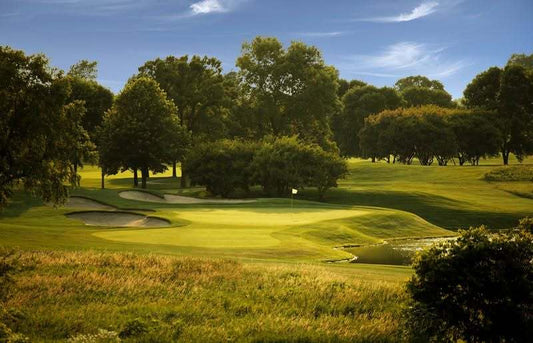


TPC River Highlands And Hazeltine
Compiled weekly by multiple-award-winning PGA Professional Brendon R. Elliott, PrimePutt’s Director of Instruction and Lead Writer.
This week gives us two very different putting conversations.
On the PGA Tour, the Travelers Championship moves to TPC River Highlands, a shorter, scoreable, risk-reward course where the closing stretch can turn into a putting sprint.
On the LPGA Tour, the KPMG Women’s PGA Championship heads to Hazeltine National Golf Club, where tiered greens, major-championship approaches and lag putting may decide who wins.
Both events will reward putting.
They will just reward different kinds of putting.
TPC River Highlands: Bent/Poa And Birdie Windows

TPC River Highlands is set up at par 70 and 6,835 yards according to the GCSAA tournament fact sheet. The greens are Bentgrass/Poa annua cut at .120 inches, with average green size around 5,700 square feet.
That combination matters.
Bent/Poa surfaces can be excellent, but they can also change subtly as the day goes on. Players who putt early may see slightly different texture than players putting late. The key at River Highlands is that the course gives players enough scoring chances that the putter cannot go cold for long.
The famous finishing stretch adds pressure.
No. 15 is a short par 4 where anything from eagle to double can happen. No. 16 is a par 3 over water to a narrow green with slope. No. 17 is a demanding par 4 where the approach carries water, and No. 18 gives players one more chance to create noise.
The putting lesson: when birdie chances are available, speed control still matters. Players who run first putts too far past the hole turn scoring holes into stress holes.
Hazeltine: A-4 Bentgrass And Tier Management

Hazeltine gives us a different style of putting test.
The GCSAA fact sheet lists the KPMG Women’s PGA setup at par 72 and 6,760 yards, with A-4 creeping bentgrass greens cut at .100 inches. The average green size is 5,000 square feet, and the course has 108 bunkers, 10 water hazards and water in play on eight holes.
This is not simply about putting well after great approaches.
It is about putting from the correct section.
The KPMG course tour points immediately to tiered greens, shelves and lag-putting demands. No. 1 has three tiers. No. 17 is large and deep with bunkers and water around it, plus narrow shelves and a bowl that can collect shots. No. 18 has three distinct tiers from front to back.
The putting lesson: at Hazeltine, a player can hit a green and still be in trouble.
The best putters this week will not only make mid-range putts. They will leave long putts in the right spots, avoid three-putts and understand when a two-putt par is a win.
PrimePutt Watch List
At TPC River Highlands: Watch the 6-to-12-footers after aggressive wedge shots. Players will have plenty of looks, but the leaderboard will favor those who convert without becoming impatient.
At Hazeltine: Watch lag putting across tiers. The player who keeps leaving herself stress-free second putts will slowly separate.
At Both Courses: Watch pace control after delays or long waits. Nothing exposes pressure faster than a player who loses speed on the first putt after standing around.
Practice Drill: Two-Course Speed Prep
Use one green and create two games.
River Highlands Game:
Hit 10 putts from 8 to 12 feet. Track makes, but also track whether your misses finish within 18 inches.
Hazeltine Game:
Hit 10 putts from 35 to 50 feet. Your only goal is to finish inside a three-foot circle.
The first game trains scoring.
The second game trains survival.
This week, both matter.
‘The Greens This Week’ drops every Wednesday and looks at the putting surfaces the best in the world from the PGA TOUR, LPGA Tour and DP World Tour will face in the coming week. Got a putting question or drill request? Drop us a line.


