
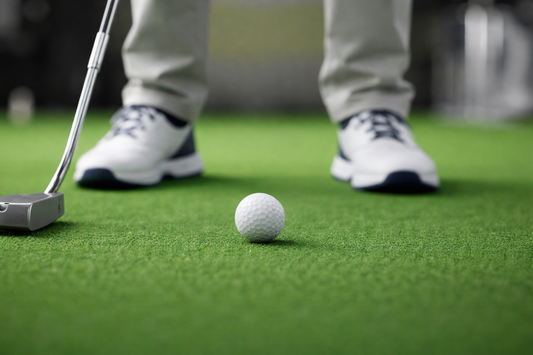


Walk into any golf shop and you'll see dozens of putters. Different shapes, different weights, different looks. Most golfers choose based on what feels comfortable or what their favorite tour player uses.
That's a mistake.
Your putter is the most-used club in your bag. You'll hit it more than your driver and irons combined. Yet most golfers spend more time getting fitted for their driver, a club they'll use 14 times per round, than their putter, which they'll use 30 to 40 times.
Putter fitting isn't complicated, but it matters enormously. The right specs can immediately improve your stroke and your results. The wrong specs force you to make compensations that hurt consistency.
Let's break down what actually matters and how to get it right.
Length: The Foundation of Everything
Putter length affects your posture, eye position and stroke path. Get this wrong and everything else suffers.
Standard putters come in 34 or 35 inches. That's fine if you're average height with average arm length and you set up in an average posture. Most of us aren't average.
Here's how to find your correct length. Set up in your natural putting posture. Your eyes should be directly over the ball or just slightly inside. Your arms should hang naturally from your shoulders with just a slight bend in your elbows. You should feel balanced and athletic, not cramped or stretched.
If you're bending over excessively or standing too upright to accommodate your putter length, you need a different length.
Shorter players generally need shorter putters, often 33 inches or less. Taller players might need 35 or 36 inches. But height isn't the only factor. Arm length and posture preference matter just as much.
A putter that's too long forces you to stand too upright or choke down on the grip, which changes the club's balance. A putter that's too short makes you bend over excessively, creating tension in your back and shoulders.
Most club fitters can cut down a putter or add length with extensions. This is simple and inexpensive. Don't settle for the wrong length just because it's what came stock.
Loft: The Misunderstood Spec
Yes, putters have loft. Most golfers don't realize this, and even fewer understand why it matters.
Standard putter loft ranges from 2 to 4 degrees. This seems like nothing compared to your wedges, but on putts, small differences matter.
Here's why putters need loft. When your ball sits on the green, it settles slightly into the grass. To get it rolling smoothly, you need to lift it just barely out of that depression. That's what loft does.
The right amount of loft depends on your stroke and your setup. If you have forward shaft lean at impact (hands ahead of the ball), you're de-lofting the putter. You might need 4 degrees of loft to end up with an effective 2 degrees at impact.
If you have the shaft vertical or leaning back at impact, you might need less loft to start with.
Most modern fitting systems use launch monitors to measure your actual loft at impact. This is the gold standard. You want to launch the ball with 1 to 2 degrees of loft for optimal roll.
Too much loft and the ball bounces before it rolls, creating inconsistent speed. Too little loft and the ball skids, again hurting consistency.
If you can't get on a launch monitor, here's a simple test. Hit some putts on a smooth green and watch the ball carefully in the first foot. It should lift very slightly, then settle into a smooth roll. If it's bouncing or skidding, your loft is off.
Lie Angle: The Accuracy Factor
Lie angle is the angle between the shaft and the ground when the putter sole sits flat. This might be the most important spec for accuracy.
If your lie angle is wrong, the toe or heel of your putter will be up in the air at address and impact. This tilts the face and sends putts off-line.
Standard lie angles are around 70 degrees, but this varies by putter model. What matters is whether the putter sits flat when you're in your natural setup.
Here's the test. Set up to a ball with your putter. Have someone look at your putter from down the line. The sole should sit completely flat on the ground. If the toe is up, your lie angle is too upright. If the heel is up, your lie angle is too flat.
Toe-up causes pulls. Heel-up causes pushes. Even a degree or two off can send a ten-footer several inches off-line.
Lie angle interacts with length. If you cut down a putter, you're making it more upright. If you add length, you're making it flatter. This is why you sometimes need to adjust lie after changing length.
Most putters can be bent to adjust lie angle. A good club fitter can do this in minutes. Some putters, especially those with adjustable hosels, let you change lie angle yourself.
How These Specs Work Together
Length, loft and lie don't exist in isolation. They affect each other and they all need to match your stroke.
Start with length. Get that right first because it determines your posture and setup. Once you have the right length, check your lie angle. Make sure the putter sits flat.
Then address loft. This is the trickiest to dial in without technology, but it's also the most forgiving. Being a degree off in loft won't ruin you. Being two inches off in length or three degrees off in lie will.
What About Weight and Balance?
These matter too, but they're more about preference than fitting.
Heavier putters (360 grams and up) tend to work better on fast greens because they resist deceleration. Lighter putters (340 grams and below) can help on slow greens where you need more speed.
Balance point (toe hang vs. face balanced) should match your stroke type. If you have an arcing stroke, you want some toe hang. If you have a straight-back-straight-through stroke, you want face balanced.
But honestly, most golfers can adapt to different weights and balances. You can't adapt to the wrong length or lie angle.
Getting Fitted
The best putter fitting involves a launch monitor and a skilled fitter who can watch your stroke. You'll hit putts with different specs while the monitor measures launch angle, ball speed and consistency.
This level of fitting costs money, usually $100 to $200, but it's worth it if you're serious about improving.
If that's not in your budget, you can do a basic fitting yourself. Check your length by setting up naturally and seeing if you're comfortable. Check your lie by having a friend watch whether your putter sits flat. Experiment with loft by trying putters with different lofts and seeing which produces the smoothest roll.
Many golf shops will do a basic fitting for free if you're buying a putter from them. Take advantage of this.
The Bottom Line
Putter fitting isn't about finding a magic club that makes you a great putter. It's about removing obstacles that prevent your natural stroke from working.
The right specs let you set up comfortably, make your natural stroke and start the ball on your intended line with good roll. The wrong specs force compensations that hurt consistency.
Most golfers are playing with putters that don't fit them. They've adapted their stroke to accommodate the club instead of fitting the club to their stroke. This works to a degree, but it limits how good you can become.
Get fitted properly and you'll immediately see better results. Your stroke won't change, but your putts will start on line more often and roll more consistently. That's worth way more than the latest insert technology or alignment aid.
Your putter should fit you like your shoes fit you. Not too big, not too small, just right. When it does, putting becomes simpler and more repeatable. And that's what we're all chasing.


