
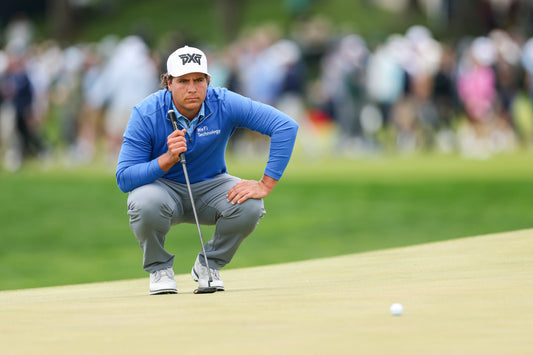


At Aronimink, the best players are not just trying to make putts. They are trying to leave themselves putts they can survive.
Every major championship has a putting story. Sometimes it is about speed. Sometimes it is about nerves. Sometimes it is about one player getting hot with the flatstick at exactly the right time.
Early at this year’s PGA Championship at Aronimink, the story feels a little different.
The greens are not just asking players to read break and control pace. They are asking a more demanding question before the putter ever comes out of the bag:
Can you leave the golf ball in the right place?
That is the lesson most everyday golfers miss when they watch a major.
They see the putts that go in. They see the three-putts that hurt. They see the short ones that slide by when the pressure rises. But the real work often happens earlier, on the approach shot, on the pitch, on the chip and even in the decision a player makes from 170 yards away.
At Aronimink, that has already become obvious.
The course setup is a true major-championship test: par 70, roughly 7,400 yards, Penn A-1/A-4 bentgrass greens, 180 bunkers and greens averaging about 8,200 square feet. That last number matters. Big greens can sound forgiving, but when they have significant slope, tiers and movement, the wrong section can make a green feel very small very quickly.
The Smartest Putting Quote Of The Week So Far
Aldrich Potgieter’s opening 67 gave us the coaching nugget.
After his round, he pointed to the value of hitting the right areas of the course, especially on the greens. The key was not having to putt across the biggest slopes and leaving himself in good positions on the putting surfaces.
That is a mature putting thought.
It is also something every amateur golfer can learn from.
Potgieter did not frame his success as simply rolling the ball beautifully. He framed it around where he left the ball. That is different. That is course management. That is putting strategy before putting stroke.
As coaches, we should love that.
Because for most golfers, the easiest way to reduce three-putts is not to become a dramatically better green reader overnight. It is to stop leaving yourself so many putts that are nearly impossible to judge.
Aronimink Is Punishing The Wrong Miss
Xander Schauffele summed up the challenge well after opening with 68. The combination of thick rough, wind, difficult greens and tucked hole locations made scoring harder than some expected.
That is the perfect recipe for uncomfortable putting.
When players miss fairways, they lose spin control. When they lose spin control, they struggle to place the ball in the right section of the green. When they miss the correct section, suddenly, a 35-footer is not just a 35-footer. It is a 35-footer up a tier, over a ridge, across a fall line or down a slope where stopping the ball near the hole becomes the real challenge.
Min Woo Lee also noted that some hole locations were placed on slopes and forced players to think carefully about where not to leave the ball.
That is major championship putting at its best.
It does not just reward the player who can make a 12-footer. It rewards the player who can avoid leaving the 12-footer that breaks four feet downhill, with the tournament starting to squeeze.

The PrimePutt Lesson: Stop Aiming Only At The Hole
Here is where the lesson becomes useful for everyday golfers.
Most amateurs aim at the flag far too often.
They see the hole. They aim at the hole. They fire at the hole. Then they wonder why the first putt feels impossible.
Better players think differently. They ask:
Where is the easiest two-putt from?
That question changes everything.
It may mean aiming 15 feet right of a left pin because the middle of the green leaves an uphill putt. It may mean playing short of a back hole location because long is dead. It may mean accepting a 25-foot birdie putt instead of chasing a tucked flag that brings a bunker, rough or severe downslope into play.
This is not conservative golf. It is intelligent golf.
At Aronimink, the players who survive are not just the players who can putt. They are the players who understand that putting starts with placement.
Big Greens Do Not Always Mean Easy Greens
One of the biggest mistakes golfers make is assuming a big green is an easy green.
A big, flat green can be forgiving. A big, sloped green can be terrifying.
Aronimink’s green complexes are a reminder of that. Golf Channel’s hole-by-hole look at the course points to several examples: the severely sloped seventh green, the 10th green surrounded by water, rough and collection areas, the uphill approach to the 11th, where a shot with too much spin can roll far back down the fairway, the elevated two-tiered 12th green and the large terraced 18th green.
That is not just architecture. That is a putting exam.
If you are on the correct side of a ridge, you may feel like you have a real chance. If you are on the wrong side, you may be hoping to escape with two putts. If you short-side yourself, the first putt or chip may be more about survival than scoring.
That is the part recreational golfers should notice.
The best players in the world are not immune to bad positions. They simply spend more energy trying to avoid them.

PrimePutt Practice: The “Right Section” Putting Drill
Here is a simple way to bring the Aronimink lesson to your own practice.
Find a practice green with some slope. Do not start by putting to a hole. Start by picking sections.
Choose three putting zones:
1. An uphill zone
2. A sidehill zone
3. A downhill zone
From 25 to 40 feet, roll three balls to each zone. Your goal is not to make the putt. Your goal is to finish the ball in a three-foot circle around your target section.
This teaches the skill that matters most on sloping greens: speed control with awareness of where the ball should finish.
Once you can do that, add the hole back in.
Now hit putts from those same three zones and notice the difference. The uphill putt feels manageable. The sidehill putt demands better pace. The downhill putt may feel defensive from the start.
That is the point.
You are not just practicing stroke mechanics. You are training your eye to recognize which putts are friendly and which putts are dangerous.
PrimePutt Practice: The “Chip To A Putt” Challenge
This lesson should not stop on the green.
Take three golf balls and place them just off the green. Pick a hole on a slope. Before you hit the chip, identify the best place to leave the putt.
Not the closest place.
The best place.
Those are not always the same thing.
A chip that finishes six feet below the hole may be better than one that finishes four feet above it. A putt from the correct side of the cup may be easier than a slightly shorter putt across the fall line.
This is how better players think. They are not just trying to hit a good chip. They are trying to leave a good putt.
That is a massive difference.
What Aronimink Is Really Teaching Us
The greens at this PGA Championship are already giving golfers a valuable reminder.
Putting is not only about the stroke.
It is about planning. It is about speed. It is about discipline. It is about understanding when the center of the green is your friend and when chasing a flag is really just inviting trouble.
The best putters are not always the players who make the most heroic putts. Many times, they are the players who leave themselves the fewest impossible ones.
That is the PrimePutt takeaway from Aronimink.
Before you blame your stroke, ask a better question:
Did I leave myself the kind of putt I had a real chance to handle?
If the answer is no, the lesson may have started long before you pulled the putter.


