


How Lord Byron’s childhood putting games can help golfers build a better mind on the greens
Byron Nelson’s place in golf history is secure for all the reasons most fans know. The smooth swing. The legendary 1945 season. The 11 consecutive wins. The 52 PGA Tour victories. The five major championships. The quiet class that made “Lord Byron” one of the game’s most respected figures.
But with THE CJ CUP Byron Nelson on the golf calendar this week, there is another part of Nelson’s story worth revisiting.
It is not just about how beautifully he struck the ball.
It is about how he prepared himself to handle pressure before pressure ever arrived.
Nelson once talked about the putting games he played as a young golfer. He would stand over an 8- or 9-footer and imagine that the putt was for something much bigger than a casual practice session. Maybe it was to win a championship. Maybe it was to save a round. Maybe it was the kind of putt a golfer dreams about long before getting the chance to hit one that really counts.
That is where the lesson lives.
Most golfers practice putting with no consequence, then get frustrated when a four-footer feels different on the course. The truth is simple: a putt only feels unfamiliar under pressure if you have never practiced it with pressure attached.
Nelson seemed to understand that long before sports psychology became part of the modern golf conversation.
Practice Should Feel Like It Means Something
There is a big difference between rolling putts and practicing putting.
Rolling putts is what many golfers do before a round. A few from three feet. A few from 10 feet. Maybe a lag putt or two across the green. No structure. No consequence. No memory being built.
Practicing putting is different.
It has a target. It has a routine. It has a result. Most importantly, it asks the golfer to care about the putt before the scorecard forces them to care.
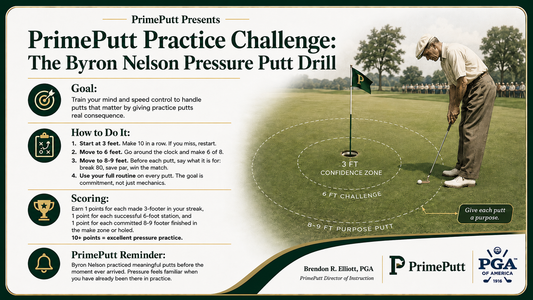
That is the beauty of the Byron Nelson Pressure Putt Drill. It does not require complicated mechanics or a long technical checklist. It asks golfers to train the part of putting that often breaks down first: commitment.
When a putt matters, your stroke needs a calm mind behind it. That calm does not come from hoping. It comes from having already been there in practice.

The Byron Nelson Pressure Putt Drill
This drill is built around three putting zones: three feet, six feet and eight to nine feet. Each station has a different purpose.
The three-foot station builds confidence.
The six-foot station trains start line and routine.
The eight- to nine-foot station adds imagination, consequence and pressure.
Together, they create a putting session that feels much closer to real golf.
Station 1: The Three-Foot Confidence Zone
Start three feet from the hole.
Make 10 putts in a row. If you miss, start over.
This may sound simple, but that is the point. Great putters do not treat short putts casually. They use the same routine, same pace and same commitment whether the putt is for a practice drill or to save par.
The three-foot station teaches discipline. It reminds you that short putts are not throwaways. They are the foundation of confident putting.
Station 2: The Six-Foot Challenge
Move to six feet and go around the clock.
Place putts at different points around the hole. Your goal is to make six out of eight.
At this distance, the putt is still makeable, but the demand increases. You need a better read. You need a better start line. You need to match pace and line. Most of all, you need to stay in your routine when the result is not automatic.
This is where many golfers begin to reveal their habits. Some rush. Some steer the putter. Some get careful instead of committed.
The goal is not perfection. The goal is to hit each putt with a clear decision and a confident stroke.
Station 3: The Eight- To Nine-Foot Purpose Putt
Now move back to eight or nine feet.
Before each putt, give it a purpose.
Say it out loud or quietly to yourself:
“This is to break 80.”
“This is to win the match.”
“This is to save par on 18.”
“This is to keep the round going.”
“This is for the club championship.”
Then go through your full routine and hit the putt.
This is the Byron Nelson part of the drill.
You are not just trying to make a putt. You are teaching your mind that a meaningful putt is still just a putt. Same routine. Same read. Same roll. Same commitment.
That is how pressure becomes familiar.
How To Score It
Give yourself one point for each made three-footer in your streak.
Give yourself one point for each successful six-foot station.
Give yourself one point for each committed eight- to nine-footer that finishes in your make zone or goes in.
A score of 10 or better is excellent pressure practice.
More importantly, track how you respond. Did your routine speed up? Did your stroke change? Did you get careful? Did you stay committed?
That feedback matters as much as the score.
What Golfers Can Learn From Nelson
The biggest lesson from Byron Nelson’s putting imagination is that pressure is not something you have to fear. It is something you can rehearse.
Too many golfers wait until the last three holes of a good round to find out whether their putting routine holds up. That is too late. By then, the nerves are real, the score matters and the mind is already racing.
This drill gives you a way to meet that moment before it arrives.
When you stand over an 8-footer in practice and tell yourself it matters, you are building a memory. When you go through your routine anyway, you are building trust. When you roll the putt with full commitment, whether it goes in or not, you are building the kind of putting identity that travels with you to the course.
Great putting is not only about making more putts.
It is about being the same golfer when the putt matters.
The PrimePutt Reminder
Byron Nelson’s greatness was not built on talent alone. It was built on preparation, imagination and the ability to treat big moments as something he had already seen.
That is the takeaway for every golfer.
Do not wait for pressure to show up on the course.
Put it into your practice.
Give each putt a purpose.
Then, when the moment comes, it will feel like you have been there before.


